Do Not Forsake Me Oh My Darling’s Film Jukebox

Do Not Forsake Me Oh My Darling

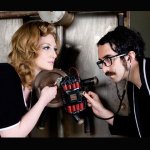
Do Not Forsake Me Oh My Darling is a loud art-rock duo from Boston that creates spy-themed music. Their first project is recording 17 songs, each inspired by an episode of the original The Prisoner series. They found it hard to narrow down their film list to 10, as they love many directors and endless B-movies, but they tried to pick films that well represented the genres that they most often enjoy. Despite the fact that they’ve seen hundreds of spy films (including every James Bond film) no spy movies made the cut! They arranged their choices chronologically. To find out more about Do Not Forsake Me Oh My Darling, visit their website.

1- The Big Sleep (1946)
In addition to being unbelievably clever and quotable, this is the quintessential film noir, and the most famous pairing of Bogart, the archetypal hard-boiled hero, and Bacall, the sassy and untamable woman. It’s smoky and stylish, and the plot is wonderfully complex. The filmmakers even managed to sneak taboo subtexts about pornography and homosexuality past the censors.

2- Rope (1948)
We are very big Hitchcock fans and it was very difficult to pick a single film to represent the unsurpassed master of film tension. The tagline from Rope – ‘It begins with a shriek…it ends with a shot.’ – was our original band name and remains the title of our blog. The Grand Guignol Rope, a film version of the play based on the true story of child murderers Leopold and Loeb, implicitly explores the dynamics of a homosexual pair obsessed with transcending morality à la Nietzsche’s Übermensch via the commission of a perfect crime.

3- Harvey (1950)
Jimmy Stewart is very heart-warming as a happy-go-lucky, head-in-the-clouds fellow whose best friend Harvey is a pooka – a six-foot, eight-inch, bunny-like creature. The movie makes us want to invite everyone we meet to dinner.

4- High Noon (1952)
The theme from High Noon was the source of the Prisoner episode entitled ‘Do Not Forsake Me Oh My Darling’, which in turn we chose as our band moniker. While technically a Western, the real-time film is a wonderful essay on honour, moral obligation, fear, and the unstoppable march of time towards the
inevitable confrontation with death.

5- Barbarella (1968)
The absolute best blend of sci-fi camp and 60s sexual revolution. The movie’s characters traipse around the galaxy carrying bizarre props through imaginative settings with absolutely brilliant sound design. It contains carnivorous dolls, a musical instrument that produces deadly orgasms, a blind angel, and a death ray. When preparing for our photo shoot, Sophia gave the make-up artist a photo of Jane Fonda as Barbarella for reference.

6- Vanishing Point (1971)
This subtle car-chase film delicately unravels an allegorical race of individuality and rebellion against inevitable capture and integration. Many of the same themes in Vanishing Point (and High Noon) are also present in The Prisoner and have inspired our songs.

7- Deathrace 2000 (1975)
Arguably the best of the Roger Corman classics – a difficult title to win in our view. Deathrace is an early role for Sly Stallone, one of Sophia’s favourites, and features David Carradine in peak form as the horribly deformed hero Frankenstein. The film focuses on society’s fascination with real death and destruction and serves as a commentary against reality television, years before it even became a… reality.

8- Boy and his Dog (1975)
This B-movie starring Don Johnson makes this list because it has the best, most unexpected ending in any movie ever. We get unlimited joy from just telling people the plot of this film: Don Johnson trots around a post-apocalyptic world telepathically communicating with his dog, whose primary purpose is to sniff out
women. Don is tricked by one of his dog-sighted conquests into entering an underground world that is a recreation of Topeka, Kansas.

9- City of Lost Children (1995)
This French film is perhaps the finest steam-punk story ever told. The dark world is crafted in the perfect combination of black and green to be timeless, and the oddball characters are right out of a circus sideshow. It is the perfect combination of sci-fi, fantasy, and surrealism with a wonderfully simple, but layered plot.

10- Primer (2004)
This mega-brainy, sci-fi, time-travel movie was made on a tiny budget and still manages to be the best sci-fi film in a long, long time. Wonderfully dense and complex, it is absolutely impossible to unravel in a single viewing – or really even 10 viewings. Slow and delicately paced, but really worth the attention.

Read Alex Fitch and Andrew Cartmel’s discussion of The Prisoner in the winter 09 issue of Electric Sheep, which looks at what makes a cinematic outlaw: read about the misdeeds of low-life gangsters, gentlemen thieves, deadly females, modern terrorists, cop killers and vigilantes, bikers and banned filmmakers. Also in this issue: interview with John Hillcoat about his adaptation of Cormac McCarthy’s The Road, the art of Polish posters according to Andrzej Klimowski and noir comic strips! And look out for our special Prisoner podcast coming soon!

Mother: Interview with Bong Joon-ho

Mother

Format: Cinema

Screening on: 14 November 2009

Venue: BFI Southbank, London

Director: Bong Joon-ho

Writers: Park Eun-kyo, Park Wun-kyo, Bong Joon-ho

Original title: Madeo

Cast: Kim Hye-ja, Won Bin

South Korea, 2009

128 mins

Part of Bong Joon-ho retrospective, 2-14 November 2009

Korean Film Festival

1-18 November 2009

Barbican + BFI Southbank (London), Manchester Cornerhouse, Nottingham Broadway

Korean Film Festival website

A dark tale about a mother who will go to extreme lengths to save her son, and a stunning blend of bewildering intensity, daring artistry and storytelling magic, Bong Joon-ho’s Mother was one of the highlights at the London Film Festival in October. Gladly, it is now already back on the big screen in the UK as part of this year’s London Korean Film Festival, playing at the BFI, which is hosting a retrospective of Bong’s small but remarkable oeuvre so far. Mother features a striking central performance from Korean TV actress Kim Hye-ja as the vigilant mother whose 28-year-old son, a shy and mentally impaired young man, finds himself framed for murder. Although there is no real evidence against him, the police are eager to close the case, and his mother has no alternative but to get involved to prove his innocence. But how far will a mother go to save her son? And how did one of South Korea’s most promising young filmmakers, who recently smashed Korean box office records with monster movie The Host (2006) approach such a topic?

Pamela Jahn had the pleasure to take part in a round table interview of Bong Joon-ho at the 2009 Cannes Film Festival in May, where Mother had its world premiere in the non-competitive Un Certain Regard section.

Q: You’ve been working on this film for almost five years, yet it seems fuelled with burning passion from beginning to end.

A: Yes, I had the general idea for the story even before The Host and I wrote a first synopsis in early 2004. That was also when I first met the main actress, Kim Hye-ja. And the fact that we could finally work together as director and actress was an unbelievable experience for me. So even while I was working on The Host and on the episode I contributed to Tokyo! (2008), in the back of my head I was already working on Mother too.

Q: When did you make the decision to cast Kim Hye-ja in the lead role?

A: It was not like the usual procedure where after writing the script I start looking for an actress who might fit the role. It’s this actress who really inspired me and got me to write the story in the first place. She is not very well known abroad, but in Korea she is an almost mythical actress, like the ‘mother of the nation’, and I had been a fan of hers since I was little. The first time I met Hye-ja it was a little surreal actually, she was almost like a dreamer. She was completely different from what I had seen on TV. So in reaction to this I wanted to show her in a role that is completely the opposite of her TV appearances and express her personality from a different point of view, looking at the hysteria and madness that lie beneath the surface of her great gentleness and warmth.

Q: How much influence did Kim Hye-ja have in the development of her character in the film?

A: I met her on a regular basis while writing the script, often several times a month, and I took some pictures that helped me a lot writing the story and developing her role.

Q:Did you also have Won Bin in mind for the role of the son while working on the story?

A: No, it was only after I finished the script that I started looking for an actor to play the son. For this character I wanted someone who would fit with her, but also someone who could make her completely mad, and Won Bin turned out to be the perfect match.

Q:In both its tone and narrative structure, Mother is very different from the films you directed before, like Memories of Murder (2003) or The Host. Why this shift in direction?

A: In Memories of Murder I wanted to represent Korean society in the 80s when it was under military dictatorship, and I liked the fact that I was dealing with a number of different themes like the family and the system, and I was exposing Korean society and the military regime by looking into the serial killings. But I got a bit tired of what was mainly a stylistic exercise and a general denunciation. So in Mother I wanted to tell a story that could be seen almost as if through a magnifying glass where the light is so concentrated that it can burn paper. I wanted to find the essence of the story. So the relationship between mother and son is the focus, and every element in the story, from the murder in the village to some other minor incidents, is there to explore this relationship in its entirety. But if you look at the film on the whole, it is not just about motherhood and their relationship, it also hints at something greater again.

Q: Did you feel a lot of pressure while making the film given that it was your follow-up feature to The Host, which was the biggest box office hit in Korean film history?

A: To be honest, I am a little bit uncomfortable with that, and I really hope that there will be a Korean movie coming up soon to break the record. But it didn’t bother me while I was making Mother because I started working on the project way before The Host came out in Korea, so I could maintain the tone that I had intended for this film in the first place.

Q: Mother is very distinctive in style, especially in the way attention is paid to colour and locations, but there are also these wonderful moments when the mother somehow becomes isolated from the background. What was the main focus in terms of the aesthetics of the film?

A: I wanted to put the character in an extreme situation and find out how she would react. That was the most important thing for me, so everything had to fully focus on the mother character, including the style and look of the film but also the music. We had some wild discussions with the art director about the clothes that she wears and what colour could best describe her character and her thoughts. I think that the opening scene shows this very well – her madness and the feeling that she is completely out of this world. She is wearing these weird purple clothes and she is hiding her hand in her pocket. Then we hear the sound of her cutting herbs and we see blood on her finger… so, basically, it’s all in there: the fate, the tragedy and the madness. These are the main elements I tried to express in that first scene, but they also stand for the film as a whole.

Q: How is your relationship to your own mother? Did she serve as an inspiration here?

A: Well, she didn’t kill anybody [laughs]. Actually, she hasn’t seen the movie yet, and I am very excited but also a little bit worried because she also has a tendency to obsession. I mean, I am 40 years old and she is still constantly worried about me. So, yes, in some way my mother also inspired me in making the film I guess, but not primarily. And don’t tell her I said that.

Interview by Pamela Jahn

53rd London Film Festival Round Up

Henri-Georges Clouzot's Inferno

53nd LONDON FILM FESTIVAL

14-29 October 2009

LFF website

As always, the London Film Festival acted as an advance preview for some of the big releases coming out in the next few months – including Michael Haneke’s The White Ribbon, Jacques Audiard’s A Prophet, John Hillcoat’s The Road and Jim Jarmusch’s The Limits of Control. We will have full-length reviews of those films on their release, so here we have to chosen to concentrate on the surprises and unknown pleasures of this year’s festival.

Mother

Following his success with monster movie The Host, South Korean director Bong Joon-ho returns to less commercial territory in his fourth and possibly best film to date, pouring his genre-defying talent into a dazzling psychological thriller that is both a disturbing family drama and witty detective story of sorts. Mother features a striking central performance from Korean TV actress Kim Hye-ja as the vigilant mother who will stop at nothing to protect her grown-up, mentally impaired son. When the emotionally fragile Do-joon is accused of murdering a high school girl and lazy policemen squeeze a questionable confession out of him just so they can close the case, the feisty widow sets out to prove his innocence, investigating the mysterious crime herself. Pushing past the bounds of conventional film noir, Bong elegantly wraps his superbly twisted narrative in stylistically assured, smartly composed scenes while creating an atmosphere that is somewhat ironic and wonderfully sinister at the same time. A festival favourite worldwide. PAMELA JAHN

Showing as part of the Bong Joon-ho retrospective at the BFI Southbank, London, on November 14.

Metropia

Blending the acute paranoia of the best dystopian science fiction with the noir futurism of Blade Runner and Dark City, Metropia is a brilliant little gem. In a permanently dark Europe where life is mostly confined to the underground and cycling has become an extreme sport, an everyman named Roger starts following a beautiful and inevitably mysterious blonde woman who may be able to explain why he’s started hearing voices. The stunning, innovative animation creates a richly detailed world that is both fascinatingly strange and disturbingly familiar. VIRGINIE SÉLAVY

45365

Winner of the audience award at the SXSW festival, 45365 is a surprising discovery. A low-key but moving documentary, it weaves together the storylines of the inhabitants of Sidney, Ohio – from the high school kids on the all-important football team to the police in their patrol cars, the judge running for re-election and the local troublemaker and his damaged mother. Created by local filmmakers Bill and Turner Ross, the result is a subtle, intimate look at both the highs and lows of life in a small town. The film’s cinéma vérité aesthetic is brilliantly rendered; refreshingly, the young brothers reject the traditional narrative voice-overs and talking heads that so many documentaries rely on, instead letting the often lyrical visuals speak for themselves. It’s a tender, loving, and utterly captivating film. SARAH CRONIN

The Bad Lieutenant: Port of Call New Orleans

When I saw an ad for this last year, I was mystified. Now I’ve seen it, I still am, in a good way. How Werner Herzog ended up helming a kind of remake of Ferarra’s film, starring Nicholas Cage I don’t know, and don’t really want to. I prefer to think of it as a product from an alternate universe where Herzog does this kind of thing all the time. What you need to know: it’s a blast, and funny as hell, with Ferrrara’s gritty tortured Catholicism tossed in favour of wilful absurdity and a plethora of lizards. Cage is terrific, with a lopsided gait and a crackpipe laugh, torturing grannies and shaking down football stars, screaming one quotable line after another. I watched the whole thing grinning like a loon. It’s every cop show cliché reflected in a hall of mirrors – wholly indecent fun. MARK STAFFORD

Dogtooth (Kynodontas)

The well-deserved recipient of the Un Certain Regard prize at this year’s Cannes festival, Giorgos Lanthimos’s Dogtooth is an inventive and riveting film that blurs the line between the real and the utterly grotesque and is infused with a science fiction feel. The story (the less you know, the better) takes place almost entirely within the confines of a spacious family house, inhabited by a married couple and their three grown-up children, who have never set foot outside and are confined to the ludicrous universe created by their parents’ cruel games and peculiar educational methods. Opting for fixed, meticulously framed shots and a dazzling, yet unhurried visual style, Lanthimos gradually reveals the details of this twisted, self-enclosed world while crafting a consistently troubling atmosphere of hilarious otherworldliness and lurking evil. Full of amazing twists, dark, silly humour and irreverent spirit, Dogtooth is an obscure mini-marvel not to be missed. PAMELA JAHN

Planned UK release.

44 Inch Chest

Colin (Ray Winstone), is lying, drunk as a lord, on the floor of his trashed house, listening to Nilsson’s ‘Without You’, on repeat. His wife (Joanne Whalley) has revealed that she loves someone else and he isn’t taking it well. His crew of dodgy old geezers (John Hurt, Tom Wilkinson, Stephen Dillane, Ian McShane) decide something must be done, so they kidnap the young loverboy and arrange for Colin to administer justice. Malcolm Venville’s 44 Inch Chest has much going for it, a great cast on cracking form, crisp photography, a meaty script by the writers of Sexy Beast, a bravura cinematic opening, and… and I really wish it didn’t all feel like an unsuccessfully retooled stage play, mainly confined to a single room, full of unreal speechifying, and with an unsatisfying conclusion to boot. Still, just hearing these actors delivering this biblically profane dialogue is a pleasure, and the thing gets pretty damned trippy and intense as we go further into Colin’s fractured mind. MARK STAFFORD

UK theatrical release: 22 January 2010.

Henri-Georges Clouzot’s Inferno (L’Enfer d’Henri-Georges Clouzot)

The long-lost raw footage of Henri-Georges Clouzot’s unfinished 1964 big-budget psycho-thriller L’Enfer is still intriguing and dazzling to look at, infused with swirling lights and blue-lipped, cigarette-puffing fantasy temptresses. A real shame, however, that although director Serge Bromberg has managed to speak to quite a few members of the original crew, this behind-the-scenes investigation has so little to say about the reasons behind Clouzot’s failure to complete the film. PAMELA JAHN

UK theatrical release: 6 November 2009.

Paper Heart

If you can put up with that whole lo-fi home-made cutesy indie scene (Demetri Martin, check, Gondryesque cardboard puppet sequences, check, naïve acoustic pop songs, check) More to the point, if you can put up with whiny-voiced scrunch-faced munchkin Charlyne Yi, then the neat central conceit of director Nicholas Jasenovic making a documentary about the search for true love destroying any hope of true love occurring by swamping a budding potential romance with his desire to film fake love clichés (kooky montages, walks on the beach, trips to Paris) will work for you. And a whole series of games with reality and illusion will open up. I can appreciate it’s a stretch. Aside from the ‘fake’ romance with Michael Cera (check) stuff, the ‘real’ documentary throws up some singular characters and amusing stories. Up to you. MARK STAFFORD

UK theatrical release: 6 November 2009.

Hollis Frampton: Hapax Legomena

The LFF offered a rare chance to see Hollis Frampton’s Hapax Legomena series of seven films in its entirety. A central figure of American avant-garde cinema of the 60s and 70s, Frampton was a supremely sharp film theorist and a witty, cerebral filmmaker. Together with Zorns Lemma, Hapax Legomena is Frampton’s most well-known work. The first film, (nostalgia), from 1971, is one of his most accessible and pleasurable, presenting a series of photographs that are burned as a narrator recounts memories and anecdotes relating to each image. The twist is that the photographs and the narration are out of sync, allowing the film to explore the relationship between image and sound as well as the nature of memory. The following six films take as their point of departure a similarly formal set-up to investigate image, space, perception, consciousness and ultimately, life. VIRGINIE SÉLAVY

Lebanon

The one-line sell for this claustrophobic little war movie runs ‘Das Boot in a tank’, and for once that’s pretty damn accurate. Based on writer-director Samuel Maoz’s experiences, it’s about the 1982 Israeli invasion of Lebanon (as seen in Waltz with Bashir), and we the audience are trapped with four ill-prepared and uneasy crew inside an armoured box dripping with sweat, muck, dog ends and soup croutons (don’t ask). We only know what they know, which is precious little, only see what they can see through their sights, and apart from the opening and closing shots of the film, we are very much inside the tank for the tight 92-minute running time. Tempers fray and victims mount, unwelcome guests are received and everything falls apart. It’s heavy-handed in places, and a little clichéd, but it feels authentic: grimy, stinky, delirious and chaotic. It works. MARK STAFFORD

Bluebeard (Barbe Bleue)

After a disappointing venture into romantic costume drama in her previous film, The Last Mistress, Catherine Breillat returns to the festival this year with a gentler and more personal work than before – a younger sister herself, she focuses on sibling rivalry. Originally scripted and produced for French television, Bluebeard is a subtly suggestive retelling of Charles Perrault’s fairy tale about an ugly and extremely wealthy lord whose wives disappear after a year under mysterious circumstances until he falls for the much younger Marie-Catherine who agrees to marry him in order to escape the shadow of her beautiful, talented older sister. What makes this understated, low-budget film a pure pleasure is the bold, teasing dialogue between the two sisters in the film’s framing plot, set in modern time, in which Catherine, the younger girl, thoroughly enjoys terrifying her older sister Anne by reading her the infamous tale from a book in the attic. Playfully grim and increasingly disturbing, with a wonderfully cruel narrative that hints at the fiercely, sexually provocative spirit of Breillat’s previous work, Bluebeard slowly inveigles you before hitting you hard. PAMELA JAHN

Planned UK release.

Samson and Delilah

In a decidedly Third World aboriginal community in central Australia, we watch gas huffing ne’er-do-well Samson and dutiful Delilah start an awkward, almost wordless teenage relationship. Warwick Thornton’s fine film sets up a world out of repeating daily rhythms and rituals (a chugging ska band, ants, solvent abuse, an unanswered telephone, taking wheelchair-bound Nana to the health clinic), and then upsets it to devastating effect. Our young couple go on the run and end up on the streets of a nameless suburban sprawl, where bad things happen. Samson and Delilah is visually accomplished, funny and moving, putting the audience through tension, fear, and despair before delivering a moment of sweet heart-tugging release. And then it carries on for another half an hour. Ah well. MARK STAFFORD

Kinatay

If it hadn’t been for Antichrist, Filipino director Brillante Mendoza’s second feature Kinatay might well have been the most controversial Cannes entry this year. To a large extent filmed in real time and adopting a detached, observational style, Kinatay depicts the kidnapping, rape, murder and dismemberment of a drug-addicted stripper as seen through the eyes of a participating police academy student. This is certainly not a film for everyone, but it is a bewildering and uncompromising screen experience that explores very murky moral territory. PAMELA JAHN

We Live in Public: Interview with Ondi Timoner

We Live in Public

Format: Cinema

Release date: 13 November 2009

Venues: Greenwich Picturehouse, Odeon Panton St, Ritzy (London) and key cities

Distributor: Dogwoof

Director: Ondi Timoner

USA 2009

90 mins

What do you do next, once you’ve won a Grand Jury Prize at the Sundance Film Festival? Well, if you’re Ondi Timoner, you make another documentary and you win the Grand Jury Prize again (making you the only individual to have won the gong twice!). The first of those two films, Dig! (2004), charted the mixed fortunes of two bands, Brian Jonestown Massacre and The Dandy Warhols. While she was making it, Timoner was also working on her latest award-winner, We Live in Public, a documentary shot over many years about the antics of Joshua Harris.

You probably won’t have heard of Harris, but some believe he predicted the future of the internet, not just by creating one of the first live streaming web channels, Pseudo.com, but also by conducting experiments on exactly what people would be willing to sign away for their five minutes of fame. One such experiment featured in the film was set in an underground New York ‘bunker’, where more than 100 people agreed to live in the month leading up to the millennium. The bunker was packed with cameras that followed every move made by the dwellers, who were also subjected to regular humiliating interrogations. Electric Sheep‘s Toby Weidmann met Ondi Timoner to find out more…

Toby Weidmann: How did you first meet Joshua Harris?

Ondi Timoner: I had worked at Pseudo.com for a little while on the Cherry Bomb show, just to pick up some extra cash while I was making Dig!. My initial impression was that he was something of a buffoon, that he was a businessman trying to buy his way into the art world. I certainly didn’t know whether he was a visionary or not – time is required to prove that. He didn’t sit around making verbal predictions either – he didn’t know what he was doing himself. But I did think he was somebody who spent his money in very extraordinary ways and I appreciated that. He affected people’s lives in that way – he was out buying bunkers in the middle of Manhattan when other people were buying houses, and that’s cool. But I didn’t know what to think of Josh…

TW: Did you have any inkling at the start how the story would pan out?

OT: I follow my subjects like I followed those ‘choose your own adventure’ books as a kid. That’s how I live my life. I have a gut feeling about certain things at certain times and so far I have been lucky enough to be picked for the gig…

TW: You are part of this story though, because you were there in the bunker, weren’t you?

OT: Yeah. Josh called me and asked whether I wanted to document cultural history. I said: ‘Always, but what do you have in mind?’ He said: ‘I can’t really tell you that, I can’t articulate that because I don’t actually know. It’s kind of unfolding, but I’ll provide you with whatever resources you need to do the job right.’ So I walk over there and they have these men moving all this metal into the building, which they were using to build the ‘pods’. Inside, there’s a guy hanging surveillance cameras from the ceiling. I asked what he was doing and he said he was putting 110 cameras in this place. And right there, I was like, ‘I’m in’. The first thing I did was to get a multiplex system so we could put all the cameras through one machine, allowing us to record the cool images, from the living pods you see in the film to the four ‘walkie’ cameras I had going, so we could ‘walkie’ out what was going on in different spaces in different rooms. We used this system as the eyes of the place. That was crucial but we still had no idea what it was all about.

TW: The film nearly wasn’t made when Harris pulled the plug on it after you edited a rough cut of the bunker material in 2000. How did it get back on track?

OT: After we won at Sundance for Dig! in 2004, I got an email from Josh asking if I was interested in finishing the film, and I really wasn’t because by then it was less relevant. But he wrote to me a few months later, and he said he would give me 50% ownership and full creative control. I thought that was a pretty good deal, and I also felt it was an opportunity to finish what I’d started – especially with no end date attached to the project. So I caught up with those who were in the bunker, and with New York post-9/11. But I still didn’t know what the film was about until I saw Facebook and read my first status update. Then I realised the bunker could be a metaphor for the internet. The only thing I was having a hard time with was the neo-fascistic elements of the bunker, because the internet doesn’t feel that way – it doesn’t feel like you’re under interrogation, it feels like you can be yourself. Then I realised that that part of the metaphor was crucial because Josh was testing the limits of how much people would be willing to give up to be a part of this. They would answer 500 questions, they would submit to these interrogations, and that became like the terms and conditions that you just accept on the internet. You never read them. Facebook owns all our content. As Josh says in the film, ‘everything is free except your image – that we own’.

TW: Are you a fan of the internet?

OT: Yeah, sure, but as powerful as it is for good, we’re paying a price. I think we’re only just becoming aware of that now. The film is definitely a dark vision of it, but it’s important to present the dark side. For a lot of people the film serves as a wake-up call. It’s a shock and it provokes all sorts of reactions. I wouldn’t have told Josh Harris’s story if it wasn’t a metaphor for all of us. There are incredible aspects that the internet brings to our lives, but our identity and our relationships are changing, and a lot of it is more superficial because we can communicate with 500 times the number of people at one time, and we can’t possibly communicate as deeply. Are your Facebook friends your friends? I don’t know, maybe you should go have coffee with them and find out. I really dislike that term – ‘Facebook friend’ – and I think it is dangerous to call them that. If that’s what friendships have become, then we have a problem.

TW: It’s being released theatrically and on DVD, but will it also be available for download? Given the subject matter, it seems well suited…

OT: It is going to be available to download, but it has to be available for the Oscars and they are old school [ie, it needs to be released theatrically first]. We feel it’s an important film, but maybe it’s a little edgy for them… We’ll see. We’re at least going to give it a shot. Dig! was disqualified from the Oscars because it went on TV too early, so we can’t put the film on the internet until then. But it should be a huge stunt when it does happen and it will be exciting to see how it does. There is a potential for We Live in Public to blaze a trail.

TW: What are you planning on making next?

OT: The story of Robert Mapplethorpe as a narrative. It’s perfect for me, right? I’ve met the Mapplethorpe Estate and I have the exclusive rights. Eliza Dushku, the actress, and I are producing it. It’s about him and his relationship with Patti Smith and about how he acted as a cultural lightning rod, pushing the boundaries of art, even beyond his death. I’m really excited about it. It’s called The Perfect Moment. I’m also engaged to make a documentary called Cool It, about the controversial environmentalist Bjørn Lomborg. He wrote a book called Cool It: The Skeptical Environmentalist’s Guide to Global Warming about global warming and economics and what we need to prioritise. It’s more of a political documentary and very different from the other films I’ve made.

Interview by Toby Weidmann

Kakera: Interview with Momoko Ando

Momoko Ando

Director: Momoko Ando

Based on the manga by: Erica Sakurazawa

Cast: Hikari Mitsushima, Eriko Nakamura

Japan 2008

Screened at the 17th Raindance Film Festival

Part of a Raindance strand on Japanese Women Directors

Date: 30 September-11 October 2009

Venue: Apollo Cinema, London

Raindance website

Kakera – A Piece of Our Lives is an effervescent debut from first-time Japanese film director Momoko Ando. An exploration of sexuality and youth, the film follows the intense relationship between two girls as they partly fumble – and partly hurtle – towards adulthood. Meeting Ando in a Soho coffee bar during the Raindance Film Festival proved a similarly madcap and engaging experience for Electric Sheep‘s Eleanor McKeown. Punctuated by cigarette breaks with her mother and Ando’s views on the sex drive of the elderly (apparently it’s better news for the fairer sex…), the discussion of Kakera was long and lively, and the director gave a passionate explanation of the film’s ideas and aesthetics.

Eleanor McKeown: One of the best things about Kakera is how you capture the intensity of the relationship between the two young girls – how did you prepare the actresses for that?

Momoko Ando: The interesting thing is that the girls who play Haru (Hikari Mitsushima) and Riko (Eriko Nakamura) are completely opposite characters in real life! Riko, for example, is really slow and really sweet. I wanted to do that kind of casting because I think girls have both sides inside themselves, both really shy and outgoing. I thought if I could bring out the actresses’ deep characters, it would probably be stronger than using how they already are in real life. I tried to ignore Hikari completely and make her really depressed and lost throughout the whole process. She got really angry and shouted at me, but that’s exactly what I was waiting for. Haru is supposed to be someone who doesn’t know what to do in her life.

EMK: Halfway through the film the character of Haru starts to gain confidence…

MA: That last shot of Hikari looking through the window at the birds during the blackout, that’s what she’s really like! I told her, you’ve already got that energy, but in the future, you will probably have to play characters like Haru, so you can’t let all your energy out all of the time, or people will think you can only do that kind of acting.

EMK: The film comes from a comic book by Erica Sakurazawa. How much of the book did you change to make it into a film?

MA: It’s a really simple story. I changed probably 80% of it. The characters had really nice dialogue and things they wanted to say in the comic book so I picked that up. I struggled quite a lot to make it more interesting because the comic book doesn’t really explain what the characters are like or their background at all. Riko isn’t a prosthetic artist, for instance. There are just two girls, a middle-aged woman and the boyfriend. So the characters are there but you don’t understand what they are.

EMK: How did the author feel about her book being made into a film?

MA: Well, the comic book is quite old. She wrote it 10 years ago, and it’s not very long, so she was quite open about it being made into a film. We got on very well, I explained to her how I felt about the comic and she felt very comfortable, I think.

EMK: The film is very intense but there’s also a certain amount of distance when dealing with the central relationship. How close did you feel to the material and characters?

MA: I was drawing on painful stuff from my past when I was writing the script and directing the film. I was definitely engaged with the whole thing, but at the same time I didn’t want to make it too deeply connected because life’s sometimes not like that. At that age, you’re probably not connected that much with life and reality because you’re too young to understand people and how deeply they feel things. I wanted to create that weird, surreal mood of youth.

EMK: The film has a really strong visual identity, especially for a debut feature. How did you plan the aesthetic?

MA: The look was really important to me. As it was my first feature film and I was only 26, I thought it would be more interesting if I worked with a cameraman who was older, probably like my dad’s age [Ando is the daughter of actor and director Eiji Okuda] – someone who makes films in a proper, old-fashioned Japanese style. If I’d worked with a young cinematographer who feels exactly the same as me, that would be more common. I decided to work with this cinematographer who’s worked on many 70s and 80s low-budget movies. He’d never worked with young film directors, especially not female filmmakers… We both thought that would be a cool plan. That’s probably why the film looks quite traditional.

EMK: You studied at the Slade College of Art in London before moving into filmmaking full-time – how do you think that influenced your visual sense?

MA: It’s something that’s quite difficult to explain, like describing a smell! You’d have to say it’s like a rose but if you don’t know what a rose is, it’s quite difficult to know what the smell is! I never really felt connected to Japanese culture. I always felt like I stood out, not always in a good way. It’s probably the same in any country but I felt more confident when I came to England, I just felt so comfortable… Also, I liked punk music.

EMK: How did you work on the soundtrack?

MA: Well, I was a crazy, huge fan of the Smashing Pumpkins when I was living in London and I happened to meet James Iha. It just worked out perfectly because what I wanted for the film was something similar to what I used to listen to when I was a teenager and James wrote the music! I knew he would write really beautiful music. It’s never depressing, always really touching and beautiful. James worked with the drumbeats first. We decided what sort of tempo we wanted for the movie and that’s why it feels like it’s all connected, always with the same beat.

EMK: How did you write the script? Did you write it as a linear story? Did you work on the dialogue first or visuals?

MA: It was definitely much more visual. I’m writing the script for my next project at the moment [which follows a female home-help drawn into becoming a prostitute for elderly gentlemen] and it’s completely original. You might think I’m weird, but I remember my dreams when I wake up and I just write all those things down. I always have bits of weird stuff in my notebook. Then I start to read it back because I kind of forget what I’ve written. And I think, ‘Oh, this is quite interesting stuff I’m writing!’ Then I decide on the concept for the next movie, what I really want to do in the film, and I start picking stuff, adding, omitting… like in cooking!

EMK: Do you think of Kakera as a woman’s film? How consciously did you decide that you wanted to treat gender? Did you have something specific to say?

MA: Yes, of course! I always dreamt of becoming a filmmaker who was quite masculine and was able to make movies like the Coen brothers – very manly – but I just found that impossible because I’m a woman and the way I think is female. Once I’d decided to make a very female film, I had so much to say. I was so conscious of gender. I had one positive message – it really doesn’t matter if you’re male or female, it’s more important how you live your life as a human being. In Japan especially, I think young girls and boys aren’t really conscious of who they are or what they are like… I was just so frustrated looking at these people: I believe you should think about how you should live your life as a good person. It’s not about being a good woman or good man.

EMK: What are your plans for the future?

MA: I’m going to be promoting Kakera because it’s going to be opening in Japan in Spring 2010. I’m halfway through my next script so when I finish it I’ll start looking for funding. Kakera is only my first film and I think that if you can’t keep making films you’re not really a director. I hope I can carry on making films. That would be amazing!

Interview by Eleanor McKeown

The Non-Commissioned Officers’ Film Jukebox

The Non-Commissioned Officers

There are many reasons for wanting to start a band, but doing so in order to promote a film is pretty unusual. When brothers Jordan and Eric Lehning were drafted in to act in indie zombie romance Make-Out with Violence and compose the score for it, they went beyond the call of duty and formed a band to help raise money for the film. The moody synth-pop of their Make-Out with Violence EP (Make Mine), full of teenage longing, eerie sounds and melancholy voices, is certainly a tantalising foretaste, and if the film is on a par with the music, it is well worth checking out – watch the trailer. Below, Eric Lehning tells us about the films that have inspired him.

1- Lawrence of Arabia (1962)
This is the best movie ever made. For months after I saw it, I thought I was supposed to become a Bedouin. Sitting there in front of the TV with an A&W root beer in my hand saying, ‘The desert calls me’. Thank god I realised it was the medium of film that inspired me. I would not make it on camel’s milk alone.

2- Blazing Saddles (1974)
Hatred has never been funnier. The way Mel Brooks smashes the N word in your face like a pie just deflates all of its malicious power. I don’t know if it’s easier for a Jew to get away with that than a honky but I’m so glad he did. My favourite line is: ‘A tollbooth!? Somebody’s gotta go back and get a shitload of dimes.’

3- The NeverEnding Story (1984)
This is a great movie to see as a child. Right off the bat the hero’s horse drowns in mud. The scene where he’s crawling through the swamp and is saved from the wolf by the Luck Dragon still makes me misty. That dragon became an incarnation of art for me as a kid. A benevolent force that dispels fear. When Fantasia is just asteroids and the Ivory Tower appears from the void, the music cue gets right on top of me.

4- Mishima: A Life in Four Chapters (1985)
Mishima should be in the Smithsonian. This is one of the most coherent, precise films ever made. It’s a movie about the Japanese artist Yukio Mishima made by Paul Schrader. The guy’s whole life is about the harmony of art and action (pen and sword). Philip Glass’s score is in a class of its own.

5- Ghost Busters (1984)
Something about really smart people scared stupid makes me feel alright about everything. Rick Moranis’s rant about the ‘form of the destructor’ is something I used to have memorised until I got a little too comfortable with a girl I was sweet on and just spewed the whole thing out over dinner. I knew I was blowing it but I was transported and had to go all the way. I went there… alone, and subsequently forgot the monologue.

6- The Empire Strikes Back (1980)
What is so strong for me about this episode of the Star Wars saga is that you could watch it without knowing anything about the other films and be left with a total sense of that world. It’s the most legit sci-fi/adventure movie of all time. Wanting to be Harrison Ford is why I don’t have a Southern accent.

7- 2001: A Space Odyssey (1968)
2001 is more than a fantasy or a genre film. It’s about the relevance of soul when put in the context of evolution. Nothing else makes me feel as human or as alien as this movie.

8- Blade Runner (1982)
Ridley Scott’s vision of the effects of overpopulation and a civilisation on overdrive is still the industry standard when imagining the near future. What’s so impressive to me is that you could actually see all those big hairdos coming back by 2016.

9- Who’s Afraid of Virginia Woolf? (1966)
Most love stories aren’t really about love, they’re about being smitten. Elizabeth Taylor and Richard Burton are so vitriolic with each other, but as soon as an outsider challenges them they become a monument of solidarity. Virginia Woolf is the best movie that’s ever been made about staying together. The damage two creatures of flesh do to each other as they attempt to be one.

10- The Dark Crystal (1982)
There’s plenty of logistical reasons why more puppet movies haven’t been made. There’s only so much Frank Oz to go around I guess. And Jim Henson’s dead. I watched this movie just the other night, and the scene where all the Skeksis are chewing down is a gross/intriguing sensory overload.

JOHNNY MAD DOG: INTERVIEW WITH JEAN-STEPHANE SAUVAIRE

Johnny Mad Dog

Format: Cinema

Release date: 23 October 2008

Venue: Curzon Renoir (London)

Distributor: Momentum Pictures

Director: Jean-Stéphane Sauvaire

Writer: Jean-Stéphane Sauvaire

Based on the novel by: Emmanuel Dongala

Cast: Christophe Minie, Diasy Victoria Vandy

France/Belgium/Liberia 2008

98 mins

Jean-Stéphane Sauvaire’s extraordinarily powerful Johnny Mad Dog finally gets a long-awaited UK theatrical release. Set in an unnamed African country, it opens with a shockingly brutal, surreally violent scene in which a pack of frenzied, coked up, brainwashed children attack villagers before walking away dressed in stolen rags, bizarre headgear and a wedding dress, brandishing guns and rifles. By adopting the point of view of the child soldiers, Sauvaire makes us experience the war through their eyes, plunging us into their perception of the senseless chaos and madness of war, avoiding any simplifying, worthy platitudes about the situation. They are both terrible victims of the war and terrifying murderers, childish and vulnerable on the one hand and capable of the most chilling acts of violence on the other. Virginie Sélavy talked to Jean-Stéphane Sauvaire about why he chose to film in Liberia, how he worked with former child soldiers and what sort of war film he wanted to make.

Virginie Sélavy: The film was adapted from the novel by Emmanuel Dongala, which is about the civil war in Congo. What made you want to turn it into a film?

Jean-Stéphane Sauvaire: The book is not really about Congo. Dongala is from Brazzaville and he used his experience in Congo, but he mixed it up with other things to create a fictional story. It is about the fight between the Dogomani and the Manidogo, he’s set the book in a generic Africa. I wanted to do something on child soldiers because I made a documentary in Colombia [in 2004] that I couldn’t complete the way I wanted. It was meant to be fiction but I turned it into a documentary called Carlitos Medellin, about the kids hired by Pablo Escobar to kill policemen and politicians because they’re minors. We received threats and I realised that we couldn’t make a documentary during the civil war in Colombia. I came across Dongala’s book and I found the story really interesting. I liked the journey of the two teenagers – in the book there’s a chapter on Johnny and one on Laokole [a young girl with a parallel experience to Johnny’s], so you follow the boy and the girl, which provides two different points of view. I found the situations described in the book very convincing, realistic and interesting.

VS: Why did you decide to film in Liberia?

JSS: At first, I thought I’d make the film in Kinshasa because I know the place better, but it’s a big city and it’s a complicated country politically. Also, the problem of the child soldiers has affected West Africa, in particular Liberia and Sierra Leone. It was important for me to film with former child soldiers and when I met them, they said not to make the film in South Africa or Senegal, which was what the producers wanted initially because Liberia had just come out of war and they didn’t think we would get insurance to film there. It was a difficult project to set up, so by the time we arrived in Liberia, it was exactly the right moment, in 2006, just after the elections. The government supported the project because internationally it showed that the country was peaceful and that you could make a film there. At the same time, they’d just come out of 14 years of war and they wanted to talk about it because it was a way of exorcising the past and avoiding doing the same thing again.

VS: How did the filming go with the children? Was it traumatic for them to relive those events or was it cathartic?

JSS: It was therapy. I spent a year doing the casting, looking for the 15 kids who were right for the film. I lived in a house with them and we started working on the film, talking and improvising. I explained cinema to them, showed them films, and they told me what happened during the war. It was always playful. They found stability there because most of them were street children who had no family left and had never been to school. With us, they had a place to sleep, and food every day. When they didn’t feel good, they would talk about what they had experienced. After that, they really started working as actors with a coach, but it was still always through games. I was worried some of the games were too simple but they loved it, they were like two-year-old kids! That was the amazing thing with them: they had the maturity of adults because they experienced things that they shouldn’t have, and at the same time they were like little kids in need of attention. As it lasted a whole year, by the end of it, they’d become actors. I made a documentary about them where you can see their evolution. It starts with the casting where the kids talk about horrifying things, which they never enacted in the film, not even in the improvisations – they never recreated the most violent things they went through.

VS: There is a documentary aspect to the film – it ends with images of real child soldiers taken during the war in Liberia between 1990 and 2003. But at the same time, you don’t set the story in a specific country and you don’t give any information about the political situation. Why did you choose to make a sort of universal fable rather than analyse the problem of child soldiers in political and social terms?

JSS: The book was already like that, it was situated somewhere in Africa and I liked that universality, to not anchor the story in a historic reality, in a war that is over and that no one cares about anymore. I remember feeling this way when I saw Hotel Rwanda: on the one hand, it’s important to show what happened, on the other hand, it happened 10 years ago and it no longer affects us. So I didn’t want to anchor the story in Liberia in 2003, with Charles Taylor – although I hesitated for a while. But ultimately, child soldiers are a universal and international issue. For me, it was about saying it happened, but also that this is still happening. It was more about what it’s like to be a child soldier than about offering a historical narrative – it was also about provoking the audience. I wanted to keep the documentary aspect but also make a fiction film to keep the emotions of the kids, and the chaos and intensity that they must have experienced.

VS: Did you think about making a documentary instead of a fiction film at any point?

JSS: Not really. It would have meant interviewing the kids after the war, so their stories would have all been similar, and it doesn’t affect you in the same way. The other alternative would have been filming kids in the middle of the war, and that would have been complicated. So it had to be realistic fiction. A war film has to be violent otherwise it is not doing what it should be doing. If you want to denounce war and the violence of war, your film has to have a minimum of violence, without descending into butchery. In Johnny Mad Dog, there is no blood. The violence is more psychological and is connected to the children, because a child with a gun, that’s already violent. The kids had a certain approach to things, a sort of energy that was quite violent.

VS: The film reminded me of Lord of the Flies, especially the scene with the head of a pig on a spike. Was it an influence on Johnny Mad Dog?

JSS: I like both the novel and the film very much and I re-read the book because there is something similar in the way the kids recreate society. But I don’t remember the scene with the pig. In the film, the kid just started kissing the pig’s head of his own accord, it wasn’t planned.

VS: I also thought of Apocalypse Now because it goes beyond other war films and really conveys the madness of war and the descent into hell it represents.

JSS: That’s one of the war films I like best, I find it more realistic than others even though it operates on a more oneiric level. I often used it as an example when people were saying to me, ‘you’re going to make a war film in Scope with beautiful images, you’re going to glorify war’. I don’t want to glorify war, but I also want to make a beautiful film. Just because you make a film about war doesn’t mean that you have to use shot-on-the-spot video images. I’m not comparing Johnny Mad Dog to Apocalypse Now because Apocalypse Now is a great film, but I never found it shocking that it was beautiful, and so I decided to use a more dream-like approach to tell the story, rather than a completely realistic one.

VS: You seem clearly more interested in the way the children perceive the events than in a straightforward chronicle of the events themselves.

JSS: Absolutely. It is about how they feel, what they have been through and how to experience it through them in a manner that is much more visceral than narrative. There are three war films that have influenced me a lot – Apocalypse Now, but also Full Metal Jacket for its realism and Come and See, a very beautiful Russian film from 1985 that inspired Spielberg’s Saving Private Ryan. In each case, we’re very close to the characters, we’re inside their heads, and I’m more interested in human films about war and people lost in the chaos than in seeing war from outside as a series of action scenes.

VS: The ending seems to suggest some hope, but it is destroyed in the very last scene, as if it was impossible to escape from the tornado of violence that has been unleashed on the country. I thought it was a very appropriate ending. Why did you choose to end the film in this way and did you think of any other possible endings?

JSS: The ending was complicated. In the book, the ending is similar but there is more hope. I didn’t like it, symbolically all the child soldiers were killed and Africa was rebuilt with the ones who’d been to school. The child soldiers are victims as much as anyone else, so I didn’t want to end it in that way. I’d written a happier end where the children all go to school, but I found it hard to film. It didn’t fit. These kids are now on the street, so I didn’t see why we’d shoot an ending where they go to school and everything ends well, because that’s not the reality. What interested me was the violence that comes out in the other main character at the end, as a result of everything that’s happened.

VS: How was it, filming in Africa as a European?

JSS: I think the story is universal and I never saw this as a problem and never encountered any. Liberia is a very peculiar country because it was created by the Americans to return black slaves so it’s the only African country that wasn’t colonised by the whites. So there’s never been this colonial relationship and there isn’t the tension you can feel in other countries.

VS: Were you accepted from the start?

JSS: Yes. Matthieu Kassovitz [who produced the film] said, ‘be careful, when I made La Haine on the estates, people were asking what I was doing there’, but I never felt that. I made the film with the people from the country, I didn’t bring a script and tell them to learn their roles, it’s a film we made together. They brought their experience of the war and I brought my experience of filmmaking. I spent two years in Liberia to really immerse myself in the country. Everybody got deeply involved, even the extras. I’m still in touch with the children because we established the Johnny Mad Dog Foundation for them. It was a beautiful adventure.

Interview by Virginie Sélavy

SECRET CINEMA: THE WARRIORS

The Warriors

Event: Secret Cinema

Date: 6 September 2009

Location: London Fields

Organised by: Future Shorts

Secret Cinema website

You can probably count on the fingers of one transatlanticly befuddled hand the number of times that anyone has mistaken Hackney for New York. Even taking into account epic jetlag combined with elephantine doses of ketamine it would still be a difficult mistake to make. Usually. Thanks to Secret Cinema and their constant urge to impress, the illusion of New York was fixed in the minds of about 2,500 London Fields visitors, most of whom were under the influence of nothing more disorientating than popcorn and good tea. This was the Secret Cinema September screening of The Warriors, their most ambitious undertaking so far.

Secret Cinema is an organisation that specialises in one-off cinema events. Each occasion is something new and each punter gets a special surprise. That’s the secret – you don’t know what you’re going to see or what’s going to happen. For The Warriors, the 1979 New York gangland odyssey, London Fields was transformed with theme park trappings and marauding handfuls of colourful gang members, done up like the gangs from the film – The Baseball Furies, The Punks, The Rogues, The Lizzies, The Hi Hats and The Satan’s Mothers. The gangs do some posing, taunt each other and occasionally break off to be chased round the park by Officer Dibble. The cool cars and cool clothes make gang membership look enticing. Luckily, there is a large fence to keep Hackney’s real miscreants out, so our blankets, mobiles and fancy dress boxes are safe. ‘Yay, Magners me up!’

The magic descended along with the darkness and then we got a rare viewing of Romain Gravas’s video clip for ‘Stress’ by Justice. Rarer still for having its kids-get-gang-kicks controversy blasted out on a big screen with big sound. ‘So French!’ applauded the Green Fiends. ‘Morally Bankrupt,’ mumbled the Flapjack Mafia.

Then the main feature. If you’re going to give people a surprise it pays to put some quality inside the wrapping. The Warriors is pure quality. Happily shorn of arseache-inducing waffle (remember, everyone is sitting out on the ground), the characters are drawn broadly but smartly and the action is happily free of guns and big on running. It also has the most sumptuously glorious lip close-ups ever committed to film. ‘Give me more of that sticky stuff’, shrieked the Southside Pouters as the film’s DJ appeared for the last time to bring the film to a close. They were to be disappointed. The Warriors were home at last and it was time for the assorted posses in the crowd to pack up their recycling and start their own happy treks back to home turf.

Nick Dutfield

Next event: Halloween special on October 31. To sign, up, visit the Secret Cinema website.

LONDON INTERNATIONAL ANIMATION FESTIVAL 09

Monsieur Cok

London International Animation Festival

27 August-6 September 2009

Various venues, London

LIAF website

The London International Animation Festival, now in its sixth edition, brought a treasure trove of animated wonders to the capital from August 27 to September 6. One of the most interesting programmes was their selection of highlights from the 2008 Siggraph Asia festival, a yearly event that showcases the most innovative computer graphics from around the world. The films were a mixture of music videos, ads, technical demonstrations of animation processes as well as narrative shorts to reflect the variety of material presented at Siggraph Asia. The more corporate or technical films were the least interesting, but the others demonstrated a breadth and richness of vision that impressed this – until now – CGI-phobe writer.

There was a number of Gothic-toned films in the selection, starting with the predictable but enjoyable Emily by Kim Leow (Canada), which told the story of a girl who seems to have the ideal parents because she can do everything she wants, until a dark twist reveals why at the end. Guy Bar’ely’s Cycle (USA) told the surprisingly affecting story of a father dealing with guilt, remembering the events leading to a terrible tragedy as he sits on an underground train. The winner of the best film award at the Siggraph Asia festival, Smith and Foulkes’s This Way Up (UK), which follows the misadventures of two undertakers as they try to take the coffin of a grand-mother to the cemetery, was funny, deliciously macabre and brilliantly animated – it was not hard to see why it won the award. This Way Up, Cycle and Emily all used the conventional type of CGI character that we have become accustomed to, but The Horrors’ video for She Is the New Thing by C Hardy (UK) used a completely different style: messy, scribbled animated drawings depicted the band being attacked and torn apart by a ghoulish woman. It was a great horror short, dark, bloody and with a suitably gruesome ending.

Also different in style was F Dion and R van den Boom’s Monsieur Cok (France). One of the longest films at 9’45, it was a satirical denunciation of the connection between war and big industry. Seemingly set during the First World War, it shows how the egg-shaped Monsieur Cok substitutes robots to the workers in his factory, who are then picked up and placed onto the conveyor belts to be turned into soldiers. But the chillingly well-oiled system is threatened when an angry, straggly, bearded former worker comes back from the war with both legs amputated, determined to make his protest heard by Monsieur Cok. Inventive, detailed and using all shades of grey to create the oppressive atmosphere of a world where beating the system seems hopelessly impossible, Monsieur Cok was one of the most accomplished films in the selection.

At the opposite end of the chromatic scale, Taku Kimura’s Kudan (Japan) was a colourful and super-quirky fable illustrating the necessity of communicating with those nearest to us through the tale of a bonzai-obsessed father who pays no attention to his son. A mysterious bell-shaped hat is delivered to their house and when the father puts it on he is taken to another world where people grow in glowing plant pots. Strange tentacular creatures float around armed with scissors, ready to sever the plants, killing the humans connected to them. As his son’s plant is about to get cut off, the father manages to save him and they both find themselves safely back home, pink letters excitedly coming out of their mouths, the father having finally learnt the joys of talking to his son.

Another outlandish delight came courtesy of the Croatian T Jantol. Wizard of OS: The Fish Incident presented itself as the remaining footage of an experiment called the Fish Incident. A golden-eyed man in a metal body hanging from a bizarre implement attached to something resembling a computer menu bar seemed to be having an ongoing battle with a fish adorned with the design of an ancient map, the various episodes taking place in different fantastical environments. It was strange, enigmatic and fascinating, and the opacity of the meaning only made this writer want to watch it again.

Finally, Martina Stiftinger’s Onde Sonore (Austria) was one of the true gems of the programme. A film she made for her thesis, it showed fish floating to the sound of music, which are left stranded as if out of water when the music stops and have to find some ingenious way of starting the gramophone again. Playing with circularity, mechanical devices and repetitive cycles, it was beautifully animated, poetic, original and quite magical.

Virginie Sélavy

ABANDON NORMAL DEVICES ROUND UP

AND

Still from The Yes Men

Abandon Normal Devices

23-27 September 2009

Various venues, Liverpool

AND website

The first Abandon Normal Devices festival, with its mix of screenings, media art and workshops, successfully established AND as an event with a strong social-political context, albeit not to the extent that a specific ‘mission statement’ was evident. This meant that the festival programme featured filmmakers and artists of diverse backgrounds and perspectives, reflecting not only the geo-political concerns of the creative community, but also offering an insight into their methods of aligning topical subject matter with their own aesthetic sensibilities. Held at various venues in Liverpool’s cultural quarter, but mostly located at FACT (Foundation for Art & Creative Technology), AND demonstrated how developments in both the technology and distribution avenues available to filmmakers have enabled their ideologies to reach a receptive audience.

Two distinctly different filmmaking personalities played key roles in AND, with Apichatpong Weerasethakul and The Yes Men offering alternative methods of political engagement. Weerasethakul, the Thai director best known in the UK for his spellbinding features Tropical Malady and Syndromes and a Century, premiered Primitive, a video installation project that was commissioned by FACT in partnership with Haus der Kunst and Animate Projects. Located in Nabua, a region of Thailand that was occupied by the military in the 1960s and where communist suspects were tortured, Primitive echoes the current political climate of Weerasethakul’s homeland, where new cases of ‘enforced disappearances’ began to emerge in 2008. While the softly-spoken Weerasethakul was a low-key figure even when attending the opening night of his exhibition, The Yes Men proved to be masters of modern media by generating feverish discussion during the first two days of AND without actually being present. The conversation revolved around the recent arrest of Yes Men co-founder Andy Bichlbaum while he was pulling a stunt in New York. Although he had made headlines earlier in the week by distributing fake copies of The New York Post to increase awareness of climate change, Bichlbaum was taken into custody on an altogether less exciting charge: arranging a gathering of more than 50 people without a parade permit. The Yes Men obviously have their legal representation on speed dial and Bichlbaum was released within 24 hours with all charges dropped. Bichlbaum’s partner in agitprop, Mike Bonanno, delivered the AND workshop on How to Be a Yes Man and, as this festival strand also included a Yes Men exhibition at John Moore’s University, not to mention a screening of the amusing if somewhat self-congratulatory The Yes Men Fix the World, it could have been cynically viewed as a thinly-veiled Yes Men recruitment drive if the political anarchists were not so self-deprecating in their pursuit of corporate satire.

In terms of screenings, the major coup was the UK premiere of Lynn Shelton’s Humpday, an intentionally uncomfortable comedy that won the Special Jury Prize at the 2009 Sundance Film Festival. A hybrid of the mumblecore movement and the more commercial ‘bromance’ genre, Humpday deals with the relationship between two recently reunited friends – one a married suburbanite, the other a bohemian backpacker – and how the dynamics between them subtly shift when they decide to make a gay porn film, despite both being of heterosexual persuasion. The loose plot builds to what is, quite literally, an anti-climax, with the ensuing awkwardness leading to laughs and longueurs in equal measure. The audience response to the Korean drama Breathless was easier to gauge, with this account of the burgeoning relationship between a thuggish debt collector and a troubled high school girl leaving most viewers shaken by its unflinching depiction of domestic violence and its refusal to offer any conventional catharsis. This tour de force by writer-director-star Yang Ik-joon is seemingly straightforward in terms of message and execution, yet its moments of dark humour and insights into familial tension make for a morally perplexing experience. Almost as emotionally gruelling was Katalin Varga, a Transylvania-set revenge tale in which a rural housewife ventures into civilisation to kill the men who raped her 10 years earlier. An intense performance by Hilda Péter in the title role and a haunting use of landscape ensure that Peter Strickland’s debut feature subverts the expectations associated with the rape-revenge genre.

However, the film that perhaps best exemplified the ethos of AND, in terms of engaging the social-political conscience in a manner that is thoughtful rather than judgemental, was Lucy Raven’s China Town, a fascinating documentary project comprised of 7,000 photographs that have been edited together to chronicle the global production of copper from the mines of Nevada to the smelters of China. By methodically capturing this process, China Town touches on such topics as globalisation and nationalism, but leaves the audience to consider the consequences of such industrial activity. The second AND festival will be held in Manchester in 2010, and should prove to be an equally interesting event if the organisers continue to balance issues with innovation.

John Berra

Read our article on Jamie King and Peter Mann’s Dark Fibre, which premiered at AND, in the autumn 09 issue of Electric Sheep. The focus is on religious extremes on film from Christic masochism to satanic cruelty with articles on biblical hillbilly nightmare White Lightnin’, Jesus Christ Saviour, a documentary on Klaus Kinski’s disastrous New Testament stage play, and divine subversives Alejandro Jodorowsky and Kenneth Anger. Plus: Terry Gilliam’s The Imaginarium of Doctor Parnassus, political animation and louche mariachi rockabilly Dan Sartain picks his top films!