THE SLEEPING YEARS’ FILM JUKEBOX

The Sleeping Years - Dale Grundle

Since the release of the Sleeping Years’ debut album ‘We’re Becoming Islands One by One’ (Rocket Girl) last year, Dale Grundle and his band have been busy playing shows in Europe and the UK. Formerly of indie darlings The Catchers, Grundle’s new project pays close attention to his Irish roots with a highly personal collection of songs swathed in gorgeous melodies, intelligent lyrics and heart-wrenching melancholy. They have just played some shows in Spain and are playing in London throughout April: catch them at The Troubadour on April 2 (solo show), The Slaughtered Lamb on April 8 (full band), at the Local (downstairs at the Kings Head – full band) on April 17 and at the Downtown Diner in Ashford, Kent, on April 30 (acoustic). For more information go to their website or MySpace. Below, Dale Grundle tells us about his favourite films. LUCY HURST

1- The Night of the Hunter (1955)
I don’t think I will grow tired of watching this. Robert Mitchum is outstanding and the movie flows from one memorable scene to the next – from Preacher Harry Powell’s hands battling for good against evil, to the children escaping along the river under the stars, to the corpse in the water… Famously, it’s the only movie actor Charles Laughton directed. Well, if you are only going to do one…

2- Stalker (1979)
The first Tarkovsky film I discovered. People travel from their monochrome town (shot by Tarkovsky in almost tar-like tones of black) in search of truth or meaning that they believe will be found in the Zone (itself shot in a subdued green). It’s not for everyone – it’s a slow movie with lots of long shots (some lasting minutes), but it’s a wonderful thing to behold.

3- Touch of Evil (1958)
It opens with an amazing three-minute uninterrupted shot winding through a Mexican border town full of characters, including a grotesque Orson Welles, Charlton Heston as a Mexican, Janet Leigh and Marlene Dietrich. It feels like a movie taking risks and certainly seems a little out of step with Hollywood at that time.

4- Invasion of the Body Snatchers (1956)
America at its most paranoid. All is not what it seems when a doctor’s reception begins to fill up with people convinced that their husbands, wives, parents are not who they are supposed to be. I still think of this movie every Xmas when I see lorries driving around with Xmas trees all bound up, pod-like in the back.

5- Jojo in the Stars (2003)
A really beautiful animated short created by Marc Craste. It’s a strange little love story set in a freak show where Jojo, the main attraction, glows brightest throughout. The animation stays in black and white and I love all the little details that appear, for instance the debris that blows up around the tower. It is worth tracking down for the soundtrack alone! Craste also directed a great video for the Icelandic band múm…

6- Wisconsin Death Trip (1999)
The stories in this docudrama are based on 19th-century newspaper articles from the town of Black River Falls in Wisconsin. German and Scandinavian immigrants come to Wisconsin in search of what they think will be the Promised Land only to find barren soil and unforgiving winters. What follows is sometimes madness, murder and a struggle to survive. I love the whisper used by the narrator Ian Holm when he speaks of someone being taken away to the Asylum. I borrowed that effect for a line in my song ‘Human Blues’. A fascinating glimpse at an episode in American history.

7- Cat People (1942)
When I was growing up I was taken to Scotland every year to spend some time with my grandfather. One of my memories from that time is staying up to watch the old RKO and Universal horror movies. Lots of shadows and fog! This film stands apart from most of those movies partly because of Jacques Tourneur’s style. Some scenes are still very powerful – I love the pool scene that uses the reflections of the water on the ceiling and the reverb of the room to great disorientating effect.

8- M (1931)
A subject that would probably be hard to film these days – that of a child killer – in a movie that gets turned on its head. M is unique in that the mark – a chalked ‘M’ – sets Peter Lorre apart even from his fellow criminals. His murders have terrorized Berlin to such an extent that the police investigations have started to interfere with the underworld’s ability to continue with their own business. Lorre is unforgettable.

9- Wages of Fear (1953)
My keyboard player Dan introduced me to this. It’s full of thoroughly dislikeable characters trapped in a small town. They are so desperate to do anything for money that they sign up to drive trucks full of nitroglycerin along a hazardous journey. The cinematography is stunning, the language is brutal and the movie full of an almost uncomfortable tension. Director Henri-Georges Clouzot thankfully seems more intent on making great cinema than pleasing his audience.

10- Hana-Bi (1997)
It’s hard to choose which of Takeshi Kitano’s movies to add to this list but let’s go for this one. Poetic, violent, infused with moments of humour and serenity – you never know where he is going to take you next. Stylish cinema with Kitano at his most deadpan.

LIDF: JOHN SAMSON RETROSPECTIVE

review_samson.jpg

London International Documentary Festival

John Samson Retrospective

Screening on: Saturday 28 March and Monday 30 March

Venue: Horse Hospital, London

LIDF website

A political activist who came of age in Scotland’s shipyards during the tumultuous 1960s, John Samson (1946-2004) discovered documentary film after he met his wife-to-be, a student at the Glasgow School of Art. Trading precision tool making for the bohemian art world, Samson began experimenting with photography before moving on to filmmaking in the early 1970s. His first short, Charlie (1973), earned him a scholarship to the National Film School.

A 2008 exhibition at London’s Seventeen Gallery that featured three of Samson’s films was entitled ‘More Quoted than Seen’, an indication of both his cult status and the paradox of his obscurity. This year, the London International Documentary Festival is featuring a special retrospective dedicated to the ground-breaking filmmaker, screening five of his rarely seen films: Tattoo (1975), Dressing for Pleasure (1977), Britannia (1979), Arrows (1979) and The Skin Horse (1983). Drawing on his own experience as an outsider, Samson’s films reflect a fascination with the lives and behaviour of people living on the margins of conservative, mainstream society.

Tattoo opens with tight close-ups of a work-in-progress: a man’s arm is being shaved, the skin prepped for a tattoo that takes shape throughout the film. Interviews with both artists and the tattooed delve into the links between exhibitionism, pain, and very personal desires. But the film’s climax lets the tattoos speak for themselves: the camera lingers on the elaborately decorated bodies of both men and women, wordlessly offering the audience a glimpse at an otherwise very private art form.

Banned by London Weekend Television, Dressing for Pleasure is an intimate, candid film about people with a rubber fetish. An interview with John Sutcliffe, the legendary clothing designer who also founded AtomAge, ‘a magazine for vinyl wearers’, is woven through the film, while blown-up pages from the magazine are used as a backdrop to the carefully composed scenes of participants parading their outré costumes. An interview with a shop assistant at Sex, the King’s Road boutique owned by Malcolm McLaren and Vivienne Westwood, one of the few places that openly sold latex and rubber wear, links fetish wear to the equally scandalous punk scene. There’s nothing deliberately sensational in Dressing for Pleasure, and what emerges is not a film about people into S&M, but a portrait of an alternative lifestyle that embraces pleasure without shame.

One of Samson’s more compelling films, despite its relatively tame subject matter, is Arrows, a 1979 film about Eric Bristow, aka The Crafty Cockney – a young, cocky champion darts player who became a national celebrity in the UK. The most captivating scenes are those of Bristow drinking pints and smoking his way through an exhibition at a working men’s club; the film is a revealing snapshot not only of Bristow, but also of an England that’s virtually disappeared.

Although there are elements in Samson’s films that are undeniably dated – notably Tattoo‘s classic 70s soundtrack – the lifestyles he captured on camera are still strikingly relevant. His refusal to sensationalise and exploit his marginalised cast of characters makes his documentaries all the more remarkable in the current era of gossip-driven reality television.

Sarah Cronin

The John Samson retrospective is screening on Saturday 28 March and Monday 30 March at the Horse Hospital (London). More details on the LIDF website.

59th BERLINALE

Love Exposure

Berlinale

5-15 February 2008

The 59th edition of the Berlinale film festival was challenging before it had even started. After a day-long delay in snowed-in Heathrow, the first film that was on offer on arrival was Sion Sono’s dizzying, daring, nearly four-hour epic Love Exposure (Ai no mukidashi). Outrageously irreverent, both visually and thematically, the film is a fast-paced saga that follows a rebellious young boy whose life is thrown into complete turmoil upon the death of his saintly mother. The only way for Yu to gain the affection of his father, who has become a Catholic priest, is to perpetually commit sins, and by doing so he eventually runs into Maria, a man-hating riot girl. Possession, perversion, mass murder, up-skirt sneak photography, Christianity and mysterious religious cults, a sprinkling of martial arts and bold references to films such as the 1970s Female Convict Scorpion series are just some of the elements that make up this unique adolescent love story. Although the film starts off at a frantic pace, it gradually slows down as the devious plot develops before concluding on a surprisingly serious and truly emotional note.

After such a thrilling start, it was difficult not to wonder whether the rest of the selection could possibly match it, and it has to be said that on the whole this year’s Berlinale was fairly downbeat and uneventful. Despite this, there were pleasures to be had: although not quite on the same level of inventiveness as Love Exposure, there was something disturbingly funny and compelling about seeing a baby sprout wings in Franí§ois Ozon’s bizarre new feature Ricky, one of the films competing for the Golden Bear. However, once again the true gems were to be found not in the official competition but in the Panorama and Forum sections. Take, for instance, When You’re Strange, Tom DiCillo’s insightful feature-length documentary, which explores the rise and fall of The Doors against the violent backdrop of the Vietnam War and the Nixon era. Incorporating previously unseen footage, it provides the first detailed record of the band’s early years on film, from their initial performances to Jim Morrison’s tragic death in Paris in 1971.

Also of note was the new film by Lucí­a Puenzo, the Argentine writer-director behind 2007’s well-received XXY: engaging and handsomely shot, The Fish Child (El Niño pez) mixed teenage romance and soft-centered thriller. This year’s Forum programme was dominated by four Korean productions, the most impressive of which was Baek Seung-bin’s debut feature Members of the Funeral (Jang-rae-sig-ui member), a quietly riveting and grimly funny drama. And the festival even offered a spot of Midnight Movie-type deviance with Dominic Murphy’s White Lightnin’, a phantasmagoric vision of the legendary ‘Dancing Outlaw’ Jesco White, who has spent most of his life battling madness, obsession and an uncontrollable wicked streak. Even though Murphy’s wild re-imagining of White’s story is at times somewhat over the top, White Lightnin’ was an enjoyable splash of cinematic ferocity, more of which would certainly be welcome in future editions of the Berlinale.

Pamela Jahn

Explore the alternative side of the Berlin film scene with our online feature on Julia Ostertag’s DIY punk film Saila or read an article on Berlin squat cinema in the new print issue of Electric Sheep. Our spring issue focuses on Tainted Love to celebrate the release of the sweet and bloody pre-teen vampire romance Let the Right One In, with articles on incestuous cinematic siblings, Franí§ois Ozon‘s tales of tortuous relationships, destructive passion in Nic Roeg‘s Bad Timing, Julio Medem‘s ambiguous lovers and nihilistic tenderness from Kí´ji Wakamatsu. Also in this issue: Interview with Pascal Laugier (Martyrs), the Polish New Wave that never existed and comic strip on the Watchmen film adaptation + much more!

BERLIN DIY PUNK FILMMAKING: JULIA OSTERTAG’S SAILA

Julia Ostertag is an underground filmmaker from Berlin on a mission to challenge representations of female characters in film, particularly those that are violent and sexualised. Coming from an art school background and finding her early influences in the cinema of transgression, she is a filmmaker whose work elicits a love or hate reaction from the audience. She delights in provocation, and her first feature Saila is further proof of this.

Ostertag recently screened Saila at Schnarup-Thumby, a tight-knit Berlin squat with a strict ‘no photography’ policy – a somewhat different venue to those chosen for the L’Oréal-sponsored 59th Berlinale which opened a few weeks later. The squat provided a particularly intense and appropriate atmosphere for a chat with Ostertag about the film and her intentions. The screening brought together the voluntary and largely amateur team that comprised Saila’s cast and crew for a manic and rewarding evening, which for Ostertag ‘mirrored the two-and-a-half-year filmmaking process itself’.

Saila centres on the title character, a dreadlocked outsider searching for a ‘lost memory’ in an increasingly violent ‘Berlin punk dystopia’, where time and space no longer appear to obey conventional rules. Through a bewildering cycle of psychosexual visions and phantasms, Saila discovers her own violent truth. As Ostertag explains, it could be described as a ‘female revenge film without a specific reason for the revenge’. One of the most dynamic elements of the film is its unpredictability. Ostertag feels that this may come from the challenging method in which it was shot: ‘neither the actors nor myself knew where the journey would take us’, she explains. ‘It was a total challenge and very different from the other shorts and docos I’ve done’, she says, referring to the spontaneous performances and to the unstructured nature of the narrative.

Saila was shot guerilla-style within urban Berlin, in abandoned warehouses, decrepit apartment blocks and industrial wastelands. This shooting style was only made possible through working with a team that knew this side of Berlin from experience – the film’s locations are situated in parts of the city that are completely off the radar for the majority of the Berlin film industry. Ostertag’s choices have paid off handsomely: although set for the most part in a fantastical post-apocalyptic future, the film displays an authenticity and genuinely punk sensibility that is impossible to feign.

The film has been described as ‘probably the Berlin Punk film right now’ and a must-see ‘if you care about the Berlin D.I.Y. scene at all’ (Andreas Michalke, 26 November 2008, berlindiyhcpunk.wordpress.com). Through Saila and her previous films, particularly documentary Gender X (Berlinale 2005) and experimental short Sex Junkie (2003), Ostertag has placed herself at the dark, pulsing heart of Berlin’s underground film scene. Her bold representations of female sexuality and the unashamed insertion of her own personal concerns within these representations (including the decision to perform in the self-sexploitative lead role in Sex Junkie) certainly deserve our attention.

The filmmaker proclaims passionately that Saila and her other films aim to ‘question civilisation’, and that they could possibly provide some answers for ‘middle-class audiences coming to a crisis’. Her films represent characters who willingly thrust themselves at the fringes of society. Ostertag wants her work to provide an alternative in an industry which to her is all about ‘creating films for TV stations’. This ability to question and to challenge through her filmmaking shines through boldly in the complexity of her female characters.

Saila contains one of the bloodiest love scenes in cinema history. It is visually harsh and yet erotically charged, its intensity heightened through the awareness that we are watching local punks on screen, not professional actors. Ostertag points out that at no point did her non-actors feel that things were going too far: ‘Not everyone’s up to rolling around in broken glass. But my actors completely slipped into their roles and the broken glass and the filth never stopped them.’ In spite of the unpredictability of the journey she took her actors on, Ostertag did attempt to prepare them for their roles by showing them films such as Richard Kern’s Submit to Me Now (1987), chosen especially to help her actors discard any assumptions about acting ‘narratively’. Although there is no conventional narrative thread to guide us through the decaying dystopia, we feel compelled to continue through the dark by Saila herself, a damaged and fascinating female character, both fragile and vampy in equal amounts. It is Saila’s predatory side that ultimately wins out, which for Ostertag is the focal point of the story as well as what drove her to make the film.

Ostertag intended the character of Saila to represent a strong female identity, a female sexual fantasy even. Many women in the audience have told her that they find Saila’s character and her sexual encounters a strong turn-on. ‘It’s especially interesting that girls are getting turned on by the aggressive sex’, she says. ‘The way I picture sex is still an important thing for me. But I like it when girls also see the romantic side of the scenes and connect to them on a very strong emotional level.’ Ostertag points out that she has also heard the opposite point of view: some women find her approach to sexuality offensive and believe she is pushing things too far. This is the filmmaker’s response: ‘I can never figure out exactly what it is that they mean by “too far”. Maybe they think that girls are not allowed to have fun in that way, even when it is depicted from a girl’s point of view.’ Ostertag concedes that as a female director it is easier to push these kinds of representations of women further, that as a female you can generally ‘get away with more’. That said, Ostertag also admits that there are very few female directors working with these concerns, particularly in such a visually provocative way.

Siouxzi Mernagh

Want to find out more about the DIY cinema scene in Berlin? Read Siouxzi Mernagh’s article about Berlin squat cinema in the new print issue of Electric Sheep. Our spring issue focuses on Tainted Love to celebrate the release of the sweet and bloody pre-teen vampire romance Let the Right One In, with articles on incestuous cinematic siblings, Franí§ois Ozon‘s tales of tortuous relationships, destructive passion in Nic Roeg‘s Bad Timing, Julio Medem‘s ambiguous lovers and nihilistic tenderness from Kí´ji Wakamatsu. Also in this issue: Interview with Pascal Laugier (Martyrs), the Polish New Wave that never existed and comic strip on the Watchmen film adaptation + much more!

INTERVIEW WITH PAOLO SORRENTINO

Il Divo

Format: Cinema

Release date: 20 March 2009

Venues: Curzons Mayfair and Soho, Renoir (London) and key cities

Distributor: Artificial Eye

Director: Paolo Sorrentinon

Writer: Paolo Sorrentino

Cast: Toni Servillo, Anna Bonaiuto, Giulio Bosetti, Flavio Bucci

Italy 2008

117 mins

Best known for his impeccably stylish modern noir The Consequences of Love (2004), Italian director Paolo Sorrentino’s latest film, Il Divo, reunites him with his Consequences star, Toni Servillo, and together they revisit the subject of Mafia involvement in Italian life. However, this time the action centres around a figure from the real world, seven-time Italian Prime Minister Giulio Andreotti, who was tried on multiple occasions for murder and corruption, but never convicted. Alexander Pashby spoke to Paolo Sorrentino during the London Film Festival in 2008.

Alexander Pashby: What was the inspiration behind Il Divo?

Paolo Sorrentino: The idea was to make a film about a character who had accompanied the lives of the Italian people for such a long time. It was something that I’d had in mind from the very beginning, when I started to enjoy cinema. And I decided to do it now because I could afford the luxury of taking a little time. There was no guarantee that I would actually be able to get this project together. I knew that it would be difficult to get funding, but at this stage of my career, it was a risk that I could take. If it wasn’t a particularly successful project, it was not going to be a disaster.

AP: Is that because of the success of Consequences?

PS: It’s really more a case of… When you want to make films, when you haven’t yet done so, you have this sense of urgency. When you’ve actually achieved your objective and made a couple of films, that degree of urgency is reduced. So there’s not that same driving need to make them relentlessly, one after the other.

AP: Andreotti is a popular author in his own right, there’s a wealth of academic writing about him and of course you lived through the events depicted in the film. How did you go about approaching…

PS: … the mass of material? Well, there was quite a lot of study and work involved, probably because I like studying. For Consequences I set myself the task of studying all the mass of material about the Mafia.

AP:I love the scene in Consequences where Toni Servillo’s character is taken to Mafia headquarters and you can really believe that every extra he passes is a member of the Mafia just from the way they look.

PS:Exactly. And in order to get there, you have to study. You have to deal with things that are real, and you have to keep to the facts otherwise you will be accused and exposed. And those true things also have to be material that is appropriate to be filmed. Not everything that is true in life is true on film. And so the difficulty with Il Divo was in the selection of the material and how to make everything fit. Because although the film takes things from reality, it becomes borderline once it’s on screen and it tends to tip over into the grotesque.

AP:Irony is very important to you, isn’t it? And the grotesque is linked to that…

PS:Yes, I always look for irony. The biography of Andreotti is the story of a man who makes an enormous use of irony himself. So it is a part of his way of dealing with things in the film. And then there’s the whole process of transforming reality into cinema reality, being distorted and turning into the grotesque. You could use the example of the scene with the cat. A man who encounters a cat, there’s nothing ironic about it, it’s a normal thing. But put it on the screen and this sort of distortion that the process imposes makes it tip over into the grotesque. That’s when you get the irony.

AP:This is the third time you’ve worked with Servillo now [the first being 2001’s One Man Up]. What’s it like working together?

PS:I wouldn’t really know how to describe it now because, having known each other for such a long time, the whole process is sort of an automatic thing. But it’s based on the fact that we get along very well. We share the same sort of ideas. We have a common view of things and that’s very, very useful.

AP:Your cinematography is very dynamic and your composition very precise. Where does that come from?

PS:I would say that it comes from what I like as a spectator. Reality is fairly random and imprecise, and if I were to make a film in which I presented something that is as imprecise and as random to my viewers, I would be afraid of boring them. So I prefer to make a film in which reality is real, but it’s also something else, and that other thing is, more or less, how I would like it to be.

Interview by Alexander Pashby

FLATPACK FESTIVAL

Megunica

Birmingham, UK, various venues

11-15 March 2009

Website

Do you remember receiving your all-time favourite compilation tape? It’s the middle of a never-ending suburban summer and you’ve just been presented with a freshly biroed track-list: an enticing roll-call of little-known B-sides and bootlegs; an exotic list of unfamiliar names and titles. Looking down at the carefully considered recommendations, you might not be able to sing along just yet but instinctively you know you’re going to love it. I’m reminded of this feeling when I meet Pip McKnight and Ian Francis, the organisers of Birmingham’s Flatpack film festival. Sitting in a café near New Street station, I’m looking through copies of their exquisitely designed festival programmes, all lovingly put together by their designer, Dave Gaskarth. They read like beautiful fanzines about rare internet shorts and breakthrough animations, about lost figures from cinema past and surreal vaudeville cabaret acts. The choices can be obscure but, like a finely crafted mixtape, there’s an inclusive and infectious enthusiasm: like friends itching to share their latest find with you.

Film graduate Ian and ex-community worker Pip first started out six years ago, putting on local film nights under the name of 7 Inch Cinema. The nights continue across Birmingham, filling pubs with eccentric bedroom animation, music video mash-ups and vintage newsreels. Building on the success of these screenings, they started to make guest appearances at festivals, showcasing their unique cinematic discoveries. Over the past 12 months, gigs have ranged from the esoteric, such as a weekend of knitting-related shorts at Warwickshire gallery Compton Verney, to mass shindigs at music festivals, including Supersonic and Green Man.

Having dipped their toes into the world of festivals (Ian also did a stint at the Birmingham Film Festival), setting up Flatpack seemed the next logical step. The somewhat unusual name came from a desire to show that ‘putting on a film show or making your own short film is not rocket science’ but, as Ian attests, organising a festival can also be bloody hard work: ‘If this festival were available to buy as a build-it-yourself cultural happening, it would come in the kind of kit that has instructions in Swedish and several vital components missing’. Working most of the year as a two-person-band from Birmingham’s cultural hub, The Custard Factory, Pip and Ian dedicate a huge amount of energy into making Flatpack a success. They certainly achieved their aim with the first two editions of the festival: a wonderfully eclectic blend of film shows and live acts, which attracted audience members from as far away as Israel. However, after the second festival in 2007, Pip and Ian grew fed up with ‘hand-to-mouth funding’ and made the ‘big decision’ to take a year out. Ian tells me that they concentrated their energies on finding some stability and creating a ‘three-year plan’ for the festival. Having secured UK Film Council funding during their break, 2009 sees the return of the festival and what Ian describes as a ‘step up in ambition’.

Although pleased to have safeguarded the festival, Pip and Ian are keen to keep it as ‘un-schmoozy’ as possible. They seem refreshingly adamant about not compromising their vision or falling into the trap of becoming too industry-focused. The tenacity of Flatpack is much needed at a time when so much festival and cinema programming is dictated by distributors. Ian and Pip want to move beyond the usual festival-going demographic and love the idea of people stumbling across the screenings by accident. They have planned installations in shops throughout the city – a paper trail of screen-based artworks – that aim to draw in unsuspecting shoppers, workers and tourists.

Given this dissident streak, Pip and Ian are particularly attracted to the eccentric entrepreneurs of early cinema. The patron saint of this year’s festival is Waller Jeffs: Birmingham’s answer to Mitchell & Kenyon. A cinematic impresario, Jeffs staged a series of film seasons (1901 – 1912) at the city’s Curzon Hall, with live sound effects and a menagerie of novelty acts (‘Unthan, the Armless Wonder’ and ‘Cyrus and Maud and their Educated Donkey’). Flatpack will kick off at Birmingham’s town hall with a selection of Jeffs’s films, accompanied by a 15-piece gypsy folk band, The Destroyers. Throughout our conversation, Pip and Ian speak excitedly about the ‘Wild West atmosphere’ of early 1900s cinema: a time when everything was new and anything was possible; a time when the audience had no boundaries and would openly react to screenings, rather than sitting in reverential silence.

This sense of drama and interaction crops up throughout the selection for Flatpack 2009, particularly in the children’s programme. Inspired by the surrealist Exquisite Corpse (‘cadavre exquis’) game, there will be a chance for groups of children to make and pass on short segments of film for others to complete. Pip and Ian themselves are particularly looking forward to Paper Cinema, a live-action treat that sees illustrator Nic Rawling moving paper cut-outs in front of a camera, making fairy tale films before the viewers’ very eyes. After Flatpack, the children’s programme will be touring Midlands schools in an attempt to move beyond the limited pool of children attending art-house cinemas.

Setting is a vital component of the Flatpack experience and Pip and Ian have devoted a lot of energy to finding exciting new venues for this year’s festival. Bringing in local set design students, they are currently decking out a dilapidated warehouse and hoping to commission murals to complement their street art film strand. This includes the award-winning Megunica, which follows Italian artist Blu; In A Dream, a portrait of legendary Philadelphian mosaic artist Isaiah Zagar; and Who is Bozo Texino?, a film about railroad graffiti that was an impressive 16 years in the making.

Pip and Ian evidently have big plans for the festival, hoping not only to raise the cultural profile of Birmingham, which, they say, needs to be better at ‘shouting about its achievements’, but also by creating a gathering point for people to experience film in a new and exciting way. And yet, when I ask them to sum up Flatpack, it’s not easy to get a direct answer. As Ian says: ‘We’ve had a job explaining what this festival is, even to ourselves at times’. It cannot be neatly encapsulated in a ‘marketing speak’ sentence. The programme is radically eclectic and, simultaneously, pleasingly cohesive. Like the perfect mixtape, the choices jump from era to era and genre to genre, yet perfectly segue into one another. You’re not quite sure how or why the selection works, but that is what makes it precisely so magical.

Eleanor McKeown

IPSO FACTO’S FILM JUKEBOX

Ipso Facto

Photo by Pavla Kopecna

London four-piece Ipso Facto have been described as ‘monochrome psychedelia’ due to their stark, dark take on garage rock and their distinctive, retro black and white image. Having recently toured with The Last Shadow Puppets, they also scooped the coveted support slot for the seminal post-punk band Magazine’s reunion tour in February 09. Their single ‘6 & ¾’ is out now on the Mute Irregulars label. Rosalie Cunningham (vocals / guitar), Cherish Kaya (keyboards), Samantha Valentine (bass) and Victoria Smith (drums) offer up some of their cinematic highlights. For more information visit their MySpace. LUCY HURST

SAMANTHA:

1- Irréversible (2002)
In Gaspar Noé’s Irréversible, the events of one traumatic night appear in reverse chronological order. It is one of the most horrifically brutal and memorable films I have ever seen – never before has a film made me physically sick. The first half hour has a background noise with a frequency of 28Hz (low frequency, almost inaudible), which causes nausea, sickness and vertigo in humans. The underlying theme of ‘le temps détruit tout’ (time destroys everything) is eerily present and a constant reminder that you should be grateful for everything you have, love and cherish. A lot of the film was improvised, which gives it a real edge, especially the 13-minute rape scene, which I still have not been able to watch the whole way through.

2- Cry Baby (1990)
I love anything by John Waters but the fact that this stars Johnny Depp swung the vote! Set in Baltimore (as always) in the 1950s, it is a classic struggle between the rebels (Drapes) and the Squares, with the Square Girl wanting to become a Drape. The film provides a cheeky two fingers up to the closed-minded prejudices and attitudes that pervade society, whatever the era. TRIVIA: Waters originally wanted Tom Cruise for the lead role, but let’s all thank god he changed his mind.

ROSIE:

3- Inland Empire (2006)
I love all David Lynch films – I love the themes, the surrealism, the way they are shot, the actors and Lynch himself. Inland Empire is my favourite, even though I had to watch it three times before I got past the first half hour, which is incredibly dark and unsettling. People try to guess the meaning and the secret behind the film and Lynch feeds this by giving out ‘clues’ in press releases, which confuses people even more. I find this hilarious – I think he enjoys winding us all up.

4- Adaptation (2002)
In a way, this film is quite similar to Inland Empire; both are set in Hollywood and merge the imaginary with reality. This film was made by the same writer/director team (Spike Jonze and Charlie Kaufman) as Being John Malkovich (another favourite of mine) and shares the same strange humour.

CHERISH:

5- American Psycho (2000)
I love this controversial film, based on the Bret Easton Ellis’ novel, which shows the protagonist Patrick Bateman’s spiralling descent into madness. The contrast between his day-to-day working life and his foray into gruesome murder after nightfall is acted brilliantly by Christian Bale (one of my top 10 actors). My favourite quotes in the film are the opening and closing sentences: ‘Abandon all hope ye who enter here’ and ‘This is not an exit’.

6- Eraserhead (1977)
David Lynch, a favourite of mine, directed this baffling surreal horror film. It troubled me, yet I felt the need to watch it over and over again. The lighting and setting alone made me feel uneasy but I still felt sympathy for each character.

VICTORIA:

7- Gummo (1997)
This was the first script written by Harmony Korine after Kids in 1995, allowing him to explore alternative cultures further. Although Gummo‘s vignettes defy a linear plot, the depiction of small-town isolation and surreal abnormalities is disturbingly enthralling. The unique costume design by actress Chloí« Sevigny and the film’s comment on the weird and wonderful ways of small-town life make Gummo unforgettable.

8- Donnie Darko (2001)
This cult classic fascinated me from the first time I watched it at the tender age of 15. I was a bit of a geek and a science fiction fiend at this point, so I found the intertwining cause-and-reaction that created the possibility for time travel amazing. It’s the story of an intelligent, frustrated schoolboy who, after a near-death experience, starts to see something dark in his future through a series of vivid, surreal dreams. As a result, every subsequent event is connected to the premonition of his death and his inevitable fate. There are many ways to interpret the ending, all of which are fascinating.

THE WEST LONDON FANTASTIC FILM SOCIETY

The Colossus of New York

The West London Fantastic Film Society

Thursday 5 February 2009

Panic in Year Zero + The Colossus of New York

AVCOM Preview Theatre, Shepherd’s Bush, London

Four days into the worst snowfall London has seen in a generation and I found myself slip-sliding my way down an insalubrious street in a dark corner of Shepherd’s Bush. The end of the street led to an unlit car park and if it wasn’t for the groups of twos and threes that were also making the same journey – a casual observer might have thought we were convening for a swingers’ party – I’d have wondered if Google maps had taken me on a wild goose chase.

On the first Thursday of most months, The West London Fantastic Film Society meet in the preview theatre of a cinema equipment company in W12 to show double bills of classic and not so classic B-movies. The first screening of 2009 included Panic in Year Zero (1962) and The Colossus of New York (1958), two films I’d never even heard of before and enjoyed considerably. Previous screenings have ranged from the ridiculous (The Creature Walks among Us) to the sublime (The Exorcist) and it is this disparate programme, which mixes forgotten gems with masterpieces of the genre, that guarantees that a small but loyal membership keeps returning.

As the number of art-house and niche cinemas continues to dwindle throughout the UK, and in London in particular, clubs like the WLFFS provide the only opportunity for fans to see older movies that are not considered worthy of showing at the venerable BFI. While the internet (both legally and illegally) has made thousands of forgotten films available again, watching a DVD at home, no matter how impressive your home cinema system, is not quite the same as seeing a celluloid print of an obscure movie projected with a group of like-minded individuals. It is this, as well as the eclectic programme, that will ensure the club’s survival.

Neither Panic in Year Zero nor The Colossus of New York is a cinematic masterpiece. The former contained about 20 minutes of monotonous footage of cars on tarmac and a soundtrack of relentlessly cheerful lift music that might drive casual viewers to distraction. But the gonzo pairing of teen idol Frankie Avalon and B-movie stalwart Ray Milland in a film that has a nuclear war going on down the road while the cast goes camping made for diverting viewing. The latter film – a fun robotic take on the Frankenstein myth – was far more engaging and had a terrific mechanical monster that shot beams out of its eyes. However, The Colossus suffered from the same problem as the risible Friday the 13th Part VIII: Jason Takes Manhattan (1989): New York was represented by a few brief shots of stock footage and anyone expecting a space age thematic sequel to King Kong got their monster movie thrills in word rather than deed. But where else could you see these films projected on a cold dismal night in February while being able to buy popcorn and hotdogs for less than a pound?

The main films, one of which is occasionally swapped for an episode of The Twilight Zone or a related documentary, are accompanied by support material. When I attended, the strange double bill of caravan apocalypse and robot brain transplant was preceded by an old newsreel documentary about kamikaze pilots during the Second World War. Later, and better still, the interval was prefaced by old 1950s and 1960s cinema adverts that were terrific to watch for both nostalgic reasons and for the juxtapositions of theme and product that seem both charming and strange to modern eyes. The WLFFS experience also involves a swap shop for Italian exploitation DVDs (starting at £2.50) and a lovingly produced programme full of stills and original poster art that even includes a reproduction of the original foyer material for one of the films, printed on card as a brilliant keepsake.

The WLFFS is attended by both fans and retired film directors. It was fantastic to have my hotdog served by Norman J. Warren, the director of Satan’s Slave (1976) and Inseminoid (1981), and his apology that Panic in Year Zero was being shown in the wrong aspect ratio was both charming and unnecessary. Norman and host Darren Perry source the films from collectors’ fairs and in fact had shown both of these titles in ‘inferior’ prints at screenings earlier in the decade, but finding better 16mm copies and an increase in members’ numbers justified a repeat showing. Another, equally unnecessary apology came from the woman sitting behind me who said, ‘the interval can tend to go on a bit long as everyone likes to catch up, but Darren does try to make sure everyone is able to get the last train home’.

I first met Darren and Norman at another small film club in Croydon, which was in a cosier venue still, as the host projected films from his kitchen (through a hole in the sliding doors) into a screen in his living room and served nibbles in the garden. If Mike Leigh had directed an episode of Spaced, I suspect it would have been not dissimilar. At one of these nights, as the interval’s cheese and pineapple on sticks was followed by a darker horror film for the second part of the double bill, the host suggested to his aunt who was sitting in the back row that she might ‘want to sit that one out as it was a bit bloody’!

Darren also volunteers as the projectionist at the Gothique film society, which meets once or twice a month at Conway Hall in Red Lion Square (next screening: Captain Kronos, Vampire Hunter) and attracts some of the loyal band of WLFFS aficionados. However, there is nothing cliquey about these affectionate, welcoming groups, which are always delighted to have new members. Film journalists at major publications regularly bemoan the disappearance of the cult screenings at the Scala in King’s Cross, but these screenings are still taking place. These days you might have to travel outside of zone 1 and wrap up warm in a cold warehouse in Shepherd’s Bush or squeeze into the front room of a semi on the A215 to Norwood, but that’s a cinematic experience as worthy as anything mainstream critics remember with rose-tinted spectacles.

The next WLFFS offers the unexpected juxtaposition of Yoko Tani as ‘the Leader of the Lystrians’ in Invasion (1965) with David Cronenberg’s perennial head-exploding classic Scanners (1981). Freak weather notwithstanding, I for one will happily be making the trip.

Alex Fitch

Contact Darren for more info about the WLFFS – £6.50 for guests / £15 membership and £4 tickets if you join – on filmhorror (at) yahoo (dot) co (dot) uk. For The Gothique film society, visit thegothiquefilmsociety.org.uk.

The Good, The Bad, The Weird: Interview with Kim Jee-woon

The Good, The Bad, The Weird

Format: Cinema

Release date: 6 February 2009

Venues: Cineworld Shaftsbury Av (London) and key cities

Distributor: Icon

Director: Kim Jee-woon

Writers: Kim Jee-woon, Kim Min-suk

Original title: Joheunnom nabbeunnom isanghannom

Cast: Song Kang-ho, Lee Byung-hun, Jung Woo-sung

South Korea 2008

120 minutes

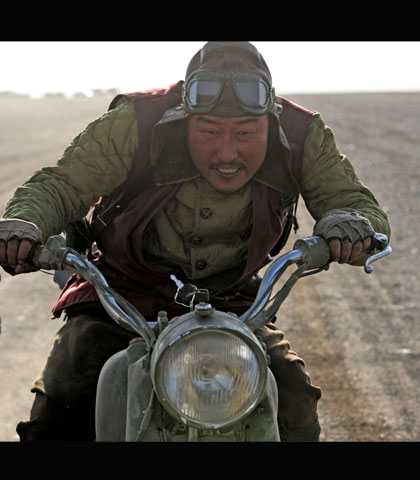
After the intelligent psychological horror movie A Tale of Two Sisters (2003) and the noir-inflected A Bittersweet Life (2005), Kim Jee-woon returns with an Asian take on the Western. The Good, the Bad, the Weird is an uproarious action-packed romp with more than a nod to Sergio Leone’s The Good, the Bad and the Ugly (1966), from the gunslingers’ supremely cool attitude in the face of death to the nonchalant whistling on the Ennio Morricone-inspired soundtrack.

Virginie Sélavy talked to the director during the London Korean Film Festival in October 2008.

Virginie Sélavy: You seem to tackle a new genre every time you make a film: you did comedy horror in The Quiet Family (1998), horror in A Tale of Two Sisters, film noir in A Bittersweet Life and now you’re taking on the Western. Is this deliberate?

Kim Jee-woon: I don’t know yet which genre I’m best at so I have to try lots of different ones! I don’t want to repeat a genre that I’ve already done because working with a variety of styles inspires me and gives me more cinematic energy. The genre I choose for each film is directly related to the theme. For example, when I chose horror, the theme of the film was the fear of things that you can and cannot see. Action films are about violence. With film noir it’s about the point at which people will break. And with a Western, the theme is revenge; it’s about strong male characters competing about who’s the best; and it’s about chasing and being chased. So when I choose a genre I choose a theme.

VS: In the credits, The Good, The Bad, The Weird is labelled an ‘oriental Western’. In what way is it different from a traditional Western?

KJW: Traditional Westerns have a low-key construction, a slow pace and simple action. I wanted to appeal to a more modern audience by making the action more powerful, by speeding up the pace and by having multi-dimensional characters, rather than just good and bad characters. Rather than just say ‘oriental Western’ I prefer to say that it’s a ‘kimchi Western’. Kimchi is a Korean dish of fermented cabbage, it’s very spicy and very hot. I like to call it that because the film reflects Korean people, who are very dynamic and spicy, just like kimchi.

VS: The Good, The Bad, The Weird was clearly very strongly influenced by Sergio Leone. Do you see your film as a homage, a parody or a re-invention?

KJW: All of them (laughs)! It started as a homage, but I tried to make it fun, with lots of humour, and I believe that there is some re-invention. It’s all of them.

VS: Why replace ‘The Ugly’ with ‘The Weird’?

KJW: Because when you call a character ‘Ugly’ it’s very limiting. But when you call a character ‘Weird’ it triggers your imagination, it makes you excited and it makes you expect more.

VS: The character of Tae-goo/The Weird, played by Song Kang-ho, seems to be the most different from the characters in both Leone’s films and in spaghetti Westerns in general. He seems closer to the type of character that Song Kang-ho also plays in The Host (2006) and in Memories of Murder (2003). At first, he seems to be a fool, but in the end he is revealed to be the most complex character in the film. Was he the character that you found most interesting?

KJW: The Tae-goo character is closer to human nature. You can identify with him. The Good and The Bad are very conventional characters, so without The Weird this film would only be entertainment. That’s why I wanted The Weird to lead the whole story, so human life was reflected through his character – it’s about how it can get complicated and how things can go wrong.

VS: You’ve said before that no one is meant to be just The Good, just The Bad or just The Weird, but Do-won seems to be the one with more good in him, Chang-yi with more bad in him and Tae-goo with more weird in him.

KJW: Initially they’re all good, bad and weird in their own way. Do-won is good, Chang-yi is bad and Tae-goo is weird, but to make things more complicated, I gave a different mission to all the characters. I told The Good that his mission was to do super-spectacular action, I told The Bad to express emotions and sensibility and I asked The Weird to lead the story and the pace of the film.

VS: There are many references to the Koreans no longer having their own country in the film. How important is the historical background to the story?

KJW: I chose that period and that place because that’s probably the most suitable time for a Western, so it’s the other way around – the story came first. But because the historical issues were very heavy during that period, whether I intended it or not, people always say there are political issues in the film.

VS: Why do you feel that this was the best period for a Western?

KJW: First of all, to make a Western it’s very important to have a place where you can ride a horse, and as you can see in the film, the endless landscape in Manchuria is perfect. There were all those countries, China, Japan, Russia, fighting for control of Manchuria at that time, so there’s this atmosphere of lawlessness that is very suitable. It also means that there are lots of different people there for different reasons and I was interested in showing this multicultural situation. And then, there are a lot of bandits, which was also perfect for a Western and I wanted to show that very rough, wild time.

VS: You say that political issues are not important, but the idea that the three main characters are free but don’t have a country comes back several times. Is the film about Korean identity in some way?

KJW: The scene where Do-won and Tae-goo talk under the moonlight is about identity and for that reason probably appeals more to Korean audiences than to Western audiences. It’s about a certain Korean sensibility.

VS: There is also a very spectacular scene in which Do-won single-handedly inflicts some serious losses on the Japanese army. It’s a great action scene but I was wondering if it was also a way of expressing some kind of anger at Japan in a humorous way?

KJW: I guess you’re right (laughs). Er… (more laughs). Yes, but it is only in a humorous way, it’s not a political statement.

REALITY FICTION: Japanese Films Based on Actual Events

Who's Camus Anyway?

6-12 February 2009

Venue: ICA, London

ICA website

TOUR DATES:

7-21 February

Watershed, Bristol

2-5 March

Queen’s Film Theatre, Belfast

11-19 March

Filmhouse, Edinburgh

9-19 March

Showroom, Sheffield

The Japan Foundation is returning to the ICA for a second year to present its new touring film programme, ‘Reality Fiction’. Featuring six films, the season explores the way Japanese directors have used actual events as the source material for their work. While the selection of films is not entirely devoted to crime drama, murder is definitely a popular theme.

Picked from the archives, the 1965 film A Chain of Islands (Nihon retto) begins with the discovery of a drowned US Army Sergeant, found floating in Tokyo Bay; the 1970 film Live Today, Die Tomorrow! (Hadaka no Jukya-sai), directed by Kaneto Shindo, probes the background and motivations of 19-year-old Norio Nagayama, who murdered four people between October and November 1968 using a gun stolen from US troops; in Junji Sakamoto’s 2001 Face (Kao), mild-mannered Masako, who kills her sister in a fit of rage, learns to live on the run in the aftermath of the devastating Kobe earthquake.

In Who’s Camus Anyway? (Kamiyu nante shiranai, 2005), Mitsuo Yanagimachi uses the motiveless killing of an elderly woman by a teenager in 2000 as the basis for a clever film-within-a-film that owes as much to pop culture and teen movies as it does to the crime genre. An impressive long take introduces us to the main characters as the camera tracks around the sunny campus of an arts college: the young, charismatic director, the cool, good-looking cameraman, even the film geek, who enthuses over the infamous opening shots in Touch of Evil and The Player. Their student project is to make a film based on the murder, but their attempts to get into the mind of the killer (which include the obligatory reading of Camus’s The Stranger) lead them into dangerous situations of their own. Yanagimachi could have done more to ramp up the suspense throughout the film, but the terrifically shot, well acted bloody ending leaves the audience unsure of where the boundary between reality and fiction lies.

A much more modest, but powerful film is Yasutomo Chikuma’s Now, I… (Ima, Boku Wa), made in 2007 with a budget of less that $5000. Chikuma, who also wrote and directed the film, plays Satoru, a 20-year-old NEET (‘not engaged in employment, education or training’) who virtually locks himself away in his bedroom in self-imposed isolation. His distraught mother stages an intervention in the form of an acquaintance who offers Satoru a job, but his refusal to engage with the outside world is virtually insurmountable. Chikuma’s sullen, monosyllabic Satoru is both infuriating and strangely endearing, while dramatic moments (which initially seem outsized for such a low-key film) make his exile all the more disturbing.

The Reality Fiction season spans a variety of budgets, eras and genres (historical drama gets a look in with Chosyu Five, about a group of samurai who travel to Europe in the mid-19th century in a bid to master Western technology), but the films all have one thing in common: a desire to understand what drives people to extreme behaviour, whether it’s murder, self-imposed seclusion or sailing halfway around the world.

Sarah Cronin